
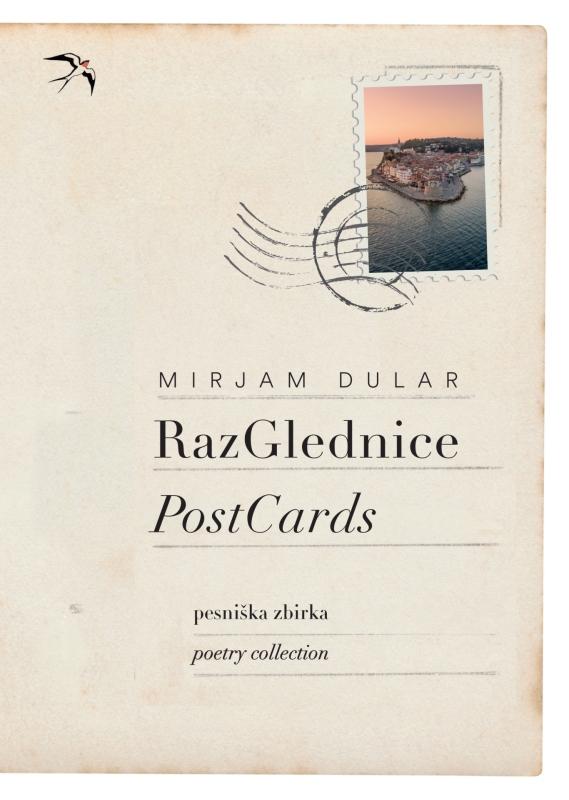
Naslovnica pesniške zbirke: Božidarka Brnas
***
Razglednica je vselej namenjena nekomu. Tudi kadar je na njej najprej kraj, pogled, nekaj zunanjega, je v njenem ozadju dvojina; nekdo, ki odhaja, in nekdo, ki ostaja; nekdo, ki piše, in nekdo drug, ki bo to nekoč prebral. Pri Mirjam Dular se ta dvojina ne vzpostavlja kot preprosta izmenjava sporočil, temveč kot prostor, v katerem se lahko dva človeka prepoznata prav skozi tisto, česar z drugimi ne moreta deliti. RazGlednice torej lahko beremo tudi kot neke vrste dopisovanje z nekom, ki je blizu in vendar vselej nekoliko odmaknjen, v drugem času, drugem jeziku, na drugi strani neke meje, ki je ni mogoče povsem določiti. Tu beremo o zavezništvu, skoraj tihem dogovoru dveh, da bosta ostala skupaj na mestu, ki ga večina ne razume. Zato tudi »polženje«, na primer, ni samo počasnost. Je način, kako ta dvojina obstaja: počasi, mehko, ranljivo, nekoliko pod kotom glede na čas, ki ga narekuje svet.
RazGlednice torej lahko beremo tudi kot neke vrste dopisovanje z nekom, ki je blizu in vendar vselej nekoliko odmaknjen, v drugem času, drugem jeziku, na drugi strani neke meje, ki je ni mogoče povsem določiti. Tu beremo o zavezništvu, skoraj tihem dogovoru dveh, da bosta ostala skupaj na mestu, ki ga večina ne razume.
Posebej zanimivo je, da se to dopisovanje ne odvija samo med dvema osebama, ampak tudi med jeziki. Notranji svetovi so kot prostor, v katerega ni mogoče vstopiti brez tveganja. Ko pesmi prestopajo iz slovenščine v angleščino, se zdi, kot da bi se morala dvojina, da bi ostala dvojina, ves čas prevajati, in kot da noben jezik pri tem ni povsem zadosten.
Mirjam Dular ne ustvarja jezika, s katerim bi se lahko poistovetili na prvo žogo, in ne govori toliko o jeziku kot bolj o prostoru med dvema človekoma, med dvema pripadnostma. Med tistim, kar je mogoče izreči, in tistim, kar ostane neprevedeno.
In prav tam se lahko začne resnično dopisovanje; ne tam, kjer se dva popolnoma razumeta, ampak tam, kjer se prepoznata v lastni nepopolni razumljivosti.
Če je v tej dvojini vselej že nekaj odmaknjenosti, pa se v RazGlednicah ta razdalja začenja razpirati. »Po daljšem času« zveni kot previden povratek k nečemu, kar je bilo za nekaj časa prekinjeno. Kot da je treba najprej preveriti, ali je mogoče znova vzpostaviti tisti drobni prostor med dvema, v katerem je mogoče govoriti. »Si?« – »Jaz. Sem.«
Besedi sta preprosti, skoraj goli, in vendar se zdi, da nosita težo vsega, kar se je medtem zgodilo. Preden lahko nadaljujeta, se morata znova prepoznati v lastni navzočnosti.
Morda se prav od tod odpre tudi »teleljubim«. Beseda je nenavadna, skoraj nerodna, a prav zato deluje zelo človeško, kot poskus, da bi za odsotnost našli novo obliko bližine. Telo drugega je daleč, vendar ljubezen ostaja v glasu, spominu, domišljiji, v svetu, ki ga gledamo namesto njega. In počasi se zdi, da se ljubljena oseba začne pojavljati tudi v stvareh – v poti, mrtvem losu, lišajih –, kot da bi se njena odsotnost razlila po pokrajini in ji dala novo čutno navzočnost. Tudi zato je konec tako telesen: »Okus po tebi. Čakam.« Ničesar ni več treba razlagati. Drugi je odsoten, a vendar ostaja v telesu, v zaznavi, v čakanju. Dvojina se je samo preselila drugam.
Morda se prav od tod odpre tudi »teleljubim«. Beseda je nenavadna, skoraj nerodna, a prav zato deluje zelo človeško, kot poskus, da bi za odsotnost našli novo obliko bližine. Telo drugega je daleč, vendar ljubezen ostaja v glasu, spominu, domišljiji, v svetu, ki ga gledamo namesto njega.
Če nekoliko špekuliram, je za RazGlednice Mirjam Dular pomembno tudi, kako se odpira čutnost in kako se čutnost pretaka iz razglednice v razglednico. Tisto, kar je bilo prej mogoče okusiti ali zaslutiti v vonju, se, morebiti nekje od dvajsete razglednice dalje, prestavi v bolj negotov, skoraj zamrznjen prostor. V štiriindvajseti razglednici voda in led obstajata hkrati, slapovi se gibljejo in obstajajo na mestu, kot da bi se svet za trenutek znašel med dvema stanjema. Tudi telo govorca je ujeto nekje vmes: nekaj v njem bi se premaknilo, vendar ostaja težko, otrplo, odrezano od gibanja.
Več preberite v knjigi Razglednice / Postcards (Hirondelle 2026)
***
A postcard is always intended for someone. Even when it primarily presents a place, a view, something external, it carries within it a duality: someone who leaves and someone who remains; someone who writes and someone who will one day read it. In Mirjam Dular’s work, however, this duality is not established as a simple exchange of messages, but rather as a space in which two people can recognize each other precisely through those things they cannot share with others. Thus, RazGlednice/PostCards may also be read as a kind of correspondence with someone who is close and yet always somewhat distant, living in another time, another language, on the far side of a boundary that can never be fully defined. Here we read of an alliance, an almost secret agreement between two people that they will remain together in a place that most others do not understand. This is why “snailing,” for example, is not merely slowness. It is a way in which this duality exists: slowly, gently, vulnerably, somewhat at odds with the time dictated by the world.
Thus, RazGlednice/PostCards may also be read as a kind of correspondence with someone who is close and yet always somewhat distant, living in another time, another language, on the far side of a boundary that can never be fully defined. Here we read of an alliance, an almost secret agreement between two people that they will remain together in a place that most others do not understand.
What is particularly interesting is that this correspondence takes place not only between two people but also between languages. Inner worlds are like a place one cannot enter without risk. As the poems cross from Slovenian into English, it seems as though the duality, in order to remain a duality, must keep translating itself, and as though no language is entirely sufficient for that task.
Mirjam Dular does not create a language one identifies with instantly, nor does she speak so much about language itself as about the space between two people, between two forms of belonging. Between what can be expressed and what remains untranslated.
And it is precisely there that true correspondence can begin: not where two people understand one another completely, but where they recognize each other through their own imperfect intelligibilities.
If there has always been an element of distance within this duality, in RazGlednice/PostCards that distance begins to open out. “After a long time” sounds like a cautious return to something that had been interrupted for a while. As though one must first test whether it is possible to re-establish that small space between two people in which conversation can exist. “Are you?” − “I. Am.”
The words are simple, almost bare, and yet they seem to carry the weight of everything that happened in the meantime. Before the two of them can continue, they must once again recognize themselves in their own presence.
Perhaps it is from here that “tele-loving you” also emerges. The word is unusual, almost awkward, yet for that very reason it feels profoundly human: an attempt to find a new form of closeness because of absence. The body of the other is far away, yet love remains in the voice, the memory, the imagination, in the world we look at in their stead. Slowly, it seems as though the beloved begins to appear in things themselves, in a path, a dead moose, lichens, as though their absence had spilled across the landscape and granted them a new sensory presence. This is also why the ending is so physical: “A taste of you. I am waiting.” Nothing more needs to be explained. The other is absent, yet remains in the body, in perception, in waiting. The duality has merely moved elsewhere.
Perhaps it is from here that “tele-loving you” also emerges. The word is unusual, almost awkward, yet for that very reason it feels profoundly human: an attempt to find a new form of closeness because of absence. The body of the other is far away, yet love remains in the voice, the memory, the imagination, in the world we look at in their stead.
If I may speculate somewhat, another important aspect of Dular’s RazGlednice/PostCards is the way sensuality opens itself and flows from postcard to postcard. What could previously be tasted or sensed in a fragrance gradually shifts, perhaps somewhere after the twentieth postcard, into a more uncertain, almost frozen space. In the twenty-fourth postcard, water and ice exist simultaneously; waterfalls move and remain still, as though the world had found itself suspended between two states. The speaker’s body is likewise caught in between: something within wishes to move, yet remains heavy, numb, severed from movement.
- The English translation was created with the assistance of artificial intelligence and editorially reviewed by Aina Ajda Ouattara.
